Generator Interlock vs Transfer Switch: What Changes, and What Does Not
Published
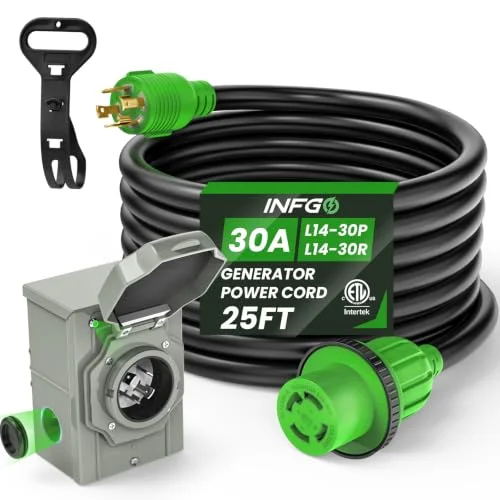
Both do the same required job: they make it impossible for the utility supply and the generator to be connected at once. An interlock is a plate on the panel you already own; a transfer switch is separate switching gear. Either way you also need an inlet box and a cord, which come matched in a 30 A kit or a 50 A kit depending on your generator’s outlet.
That last sentence is the part most comparisons leave out, and it is the part you can buy and install thinking about, rather than argue about.
What each one is
An interlock kit is a bracket that mounts on the front of your existing breaker panel, and it has to match that panel’s brand and amperage, so check the label inside the door before ordering. It carries a sliding plate positioned so that the main breaker and a dedicated generator breaker cannot both be in the on position. Flip the main off, slide the plate, flip the generator breaker on. The mechanism is entirely mechanical and there is nothing to fail electrically.
A manual transfer switch is a separate enclosure, usually a small subpanel of six to sixteen circuits, with a switching mechanism inside that moves the connected loads from utility to generator. The circuits it feeds are wired into it during installation.
An automatic transfer switch does the same thing without you, sensing the outage and starting a standby generator. It is the standby-generator answer, not the portable-generator answer, and it costs accordingly.
| Interlock kit | Manual transfer switch | Automatic transfer switch | |
|---|---|---|---|
| What it is | A plate on your existing panel | A separate switching subpanel | Sensing plus switching gear |
| Circuits available | Every circuit in the panel | Only those pre-wired into it | Only those pre-wired into it |
| Needs panel breaker space | Yes, for the generator breaker | Not usually | Not usually |
| Panel-specific | Yes, must be listed for your exact panel model | No | No |
| Operation | Manual, three movements | Manual, one switch | None |
| Typical cost | Lowest | Middle | Highest |
| Suits | Portable generators | Portable generators | Standby generators |
The one sentence the code asks for
The requirement is one sentence long: transfer equipment must prevent the utility source and the generator source from being connected simultaneously. An interlock satisfies it mechanically, which is why interlock kits are permitted as transfer equipment when they are listed for the specific panel and installed to that listing.
Two practical consequences follow, and they are the ones that decide real installations.
No listed kit, no interlock. Listings are panel-model specific. If nothing is listed for your panel, the interlock route is closed and a transfer switch is the answer.
The inspector decides. Local authorities having jurisdiction vary, and some require a device tested and certified as transfer equipment in its own right. Ask before you buy, not after.
Anything beyond that — which breaker, what wire, how the neutral and ground are handled — is work for a licensed electrician. Not because the reasoning is complicated, but because getting it wrong puts voltage on the utility line, and that is a hazard to someone who never agreed to take the risk.
The half that is identical either way
Whichever you choose, the generator stands outside and the panel is inside, and two things bridge that gap.
A power inlet box mounted on an exterior wall. Its male pins are recessed and only become live once the cord is seated, which is the whole safety argument against a double-ended cord.
A cord from the generator’s outlet to that box.
Both are sized by the connector on the generator, not by the transfer method you picked and not by the generator’s wattage badge.
| Generator outlet | Kit | Cord plug | Box | Rating | Ceiling |
|---|---|---|---|---|---|
| NEMA L14-30R | 30 A kit | L14-30P | L14-30P inlet | 30 A at 250 V | 7,500 W |
| NEMA 14-50R | 50 A kit | 14-50P | SS2-50P inlet | 50 A at 250 V | 12,500 W |
The wattage column is a multiplication rather than a marketing figure: 30 A times 250 V is 7,500 W, and 50 A times 250 V is 12,500 W, which is exactly what the two listings state. It is a ceiling, not an output. The cord carries whatever the generator actually produces, up to that limit.
The two connector families do not interchange. An L14-30 cord will not fit a 14-50 outlet and should never be adapted to one: the adapter would let a 50 A source feed a 30 A cord.
How long a cord, and why 20 feet is the answer to a different question
The CPSC’s guidance on portable generators is to run them outdoors only, at least 20 feet from the house, with the exhaust directed away from the building. Carbon monoxide is what kills people during outages, at a rate the CPSC estimates at around 85 deaths a year in the United States, and 20 feet is the distance that keeps exhaust from drifting back in.
Twenty feet is therefore the floor on how far the generator sits from the wall, which means the cord has to be longer than 20 feet plus the slack for routing. That is why the 25 ft length is the practical starting point rather than the 10 or 15 ft ones.
| Cord length | What it suits |
|---|---|
| 10 ft | Reaching a box mounted close to a permanent generator pad; too short for the CPSC distance on its own |
| 15 ft | A pad already sited well away from the wall, with the box directly opposite |
| 25 ft | The general case: 20 feet of separation plus routing slack |
| 50 ft | A generator that has to stand around a corner, or well clear of windows and doors |
Measure the actual path, not the straight line. Cords run along walls and around obstacles, and a cord stretched taut is a cord that gets unplugged.
What to specify
- The interlock if a listed kit exists for your panel, the panel has space for a generator breaker, and you want every circuit in the house available. It is the cheapest route and the most flexible.
- The manual transfer switch if no listed interlock exists for your panel, your inspector wants dedicated transfer equipment, or you would rather decide the essential circuits once and never think about load again.
- The inlet box and cord in both cases, sized by the generator’s outlet, long enough to keep the generator 20 feet out.
INFGO’s kits pair the cord and the box so the two ends match, both ETL listed, with the box pre-drilled on all four sides so the cable can enter from whichever direction the wall allows. The 30 A kit uses 10/4 AWG copper for its 7,500 W ceiling; the 50 A kit uses one 6 AWG and three 8 AWG conductors for 12,500 W.
The panel end is not a DIY job. Have the interlock or transfer switch, the generator breaker and the feed from the inlet box installed by a licensed electrician to your local code.
Frequently Asked Questions
Is a generator interlock kit as safe as a transfer switch?
When it is listed for your specific panel and installed to that listing, yes, and code treats it as transfer equipment. Both approaches satisfy the same requirement: the utility supply and the generator can never be connected at the same time. An interlock does it with a metal plate that physically blocks the two breakers; a transfer switch does it inside a switching mechanism. Your local inspector has the final say on which they will accept.
Which is cheaper, an interlock kit or a transfer switch?
The interlock, usually by a wide margin, because it is a bracket rather than a piece of switchgear and it reuses the panel you already own. The saving shrinks if your panel has no available breaker space, if no listed kit exists for your panel model, or if the panel is old enough that the electrician recommends replacing it anyway.
Does an interlock kit let me use every circuit in the house?
Every circuit stays available, which is the interlock's main advantage. It does not mean you can run them all at once. The generator's output is the limit, so you manage load by which breakers you leave on, and the whole panel is yours to choose from. A transfer switch restricts you to the circuits that were pre-wired into it.
Do I need a transfer switch if I only run extension cords?
No. Cords from the generator straight to appliances need no transfer equipment at all, because nothing connects to the house wiring. The moment you want the house's own outlets, lights and hard-wired equipment to work, you are connecting to the panel, and that connection needs an inlet box, a cord and either an interlock or a transfer switch.
What size generator cord do I need?
Match the connector on the generator, not its wattage badge. A generator with a NEMA L14-30R outlet takes a 30 A kit with an L14-30P plug, rated 7,500 W. A generator with a NEMA 14-50R outlet takes a 50 A kit with a 14-50P plug, rated 12,500 W. The two connector families do not interchange and no adapter should be used to make them.
Can I just backfeed the panel through a dryer outlet?
No. A cord with a male plug on both ends leaves exposed live pins whenever one end is unplugged, and it bypasses the interlock that keeps the generator off the utility line. Back-feeding without transfer equipment can energise the service drop and kill a lineworker. The whole point of an inlet box is that its pins are only ever live when the cord is seated in it.
The cord and inlet box, whichever you choose
INFGO's 30 A kit pairs an ETL-listed NEMA L14-30P to L14-30R cord with a pre-drilled power inlet box rated 7,500 W. Ten, 15, 25 and 50 ft lengths, 10/4 AWG copper, waterproof moulded plugs.
See the 30 A cord and inlet kit